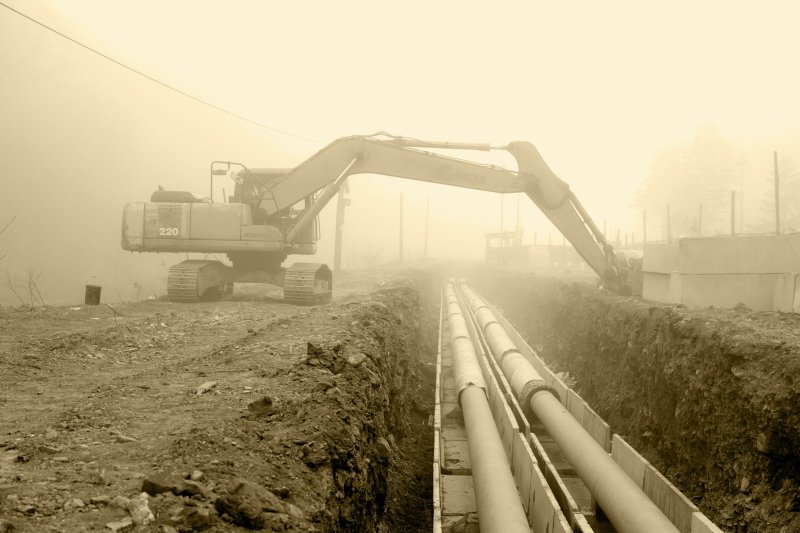
Trenchless sewer replacement in 2026 costs $5,500 to $16,000 for a typical 75 ft residential lateral, with most jobs landing around $6,000 to $12,000. Pipe bursting runs $60 to $200 per linear foot and CIPP lining runs $80 to $250 per linear foot, before permits or any add-ons. What moves the bill the most is which method your line qualifies for, plus whether the house has a usable cleanout already cut in.
Open-trench dig still wins on raw per-foot cost ($50 to $125 per linear foot), but that number doesn’t include putting the driveway, lawn, mature plantings, or stamped concrete patio back together. Once restoration is in the math, trenchless usually beats it on lines under hardscape and ties on lines under turf.
For pricing on related plumbing work, see the PEX repipe cost guide for supply-line replacement and the slab leak repair guide for under-foundation pipe repairs. The numbers below come from 2026 data published by Angi, HomeGuide , UseCalcPro, Nuflow, MrPipey, and several regional trenchless contractors, cross-checked against equipment-side specs from HammerHead and Roto-Rooter.
What trenchless sewer replacement actually costs in 2026
Most homeowners pay between $6,000 and $12,000 for a complete trenchless residential job. The headline ranges below cover the line work itself. Permits, city inspections, cleanout adds, and hardscape restoration all land separately and are broken out in the next table.
| Method | Per Linear Foot | 75 ft Lateral Total | New Pipe Material |
|---|---|---|---|
| Pipe bursting | $60–$200 | $5,500–$13,500 | HDPE, heat-fused |
| CIPP lining | $80–$250 | $7,000–$16,000 | Resin-saturated liner (epoxy or vinyl ester) |
| Pull-in-place (short spans <50 ft) | — | $3,000–$4,000 | Resin-saturated felt sleeve |
| Open-trench dig (reference) | $50–$125 | $4,500–$9,000 | PVC or HDPE, plus restoration |
Per-foot math gets distorted on short runs. Every trenchless contractor has a minimum project charge of roughly $3,500 to $6,000 to cover mobilization, the camera, the bursting rig or curing equipment, and the crew. On a 25 ft repair the effective rate looks like $200/ft. On a 100 ft job it falls toward $90/ft. That’s why short laterals can come back priced higher than the per-foot table suggests.
Diameter changes the number on commercial work, not residential. A 4-inch residential lateral runs $80 to $180/LF for CIPP. A 6-inch line (small commercial or an oversized residential) runs $100 to $220/LF. Most homes are on a 4-inch line; if your plumber quotes 6-inch pricing, ask whether they pulled the actual diameter off the camera scope or assumed.
Add-on costs that move the bill
| Item | Typical Cost | Notes |
|---|---|---|
| Sewer camera inspection (with cleanout) | $125–$500 | Most contractor-quoted scopes land in the middle of this range |
| Camera inspection (no cleanout, toilet pull) | $175–$800 | Plumber pulls a toilet, scopes through the closet flange, resets it |
| Hydro-jetting before scope | $300–$700 | Often bundled with the camera trip on root-clogged lines |
| One-way cleanout install | $650–$2,000 | Outside the foundation wall, future-proofs every later scope |
| Two-way cleanout install | $1,400–$3,500 | Lets you snake or scope upstream and downstream |
| Permit and city inspection | $300–$1,500 | Required in every U.S. municipality; $500–$1,000 typical |
| Backflow preventer install | $150–$1,150 | Often required by code on basement bathrooms |
| Hardscape restoration (if pits are under it) | $2,000–$8,000 | Concrete driveway repour is the killer line item |
Major-metro markets add 20 to 35% on top of the national figure. NYC, San Francisco, Boston, Seattle, plus DC are the worst, mostly because of permit complexity and shorter contractor schedules. Source: 2026 UseCalcPro sewer replacement calculator .
Pipe bursting vs CIPP: which one matters for your line
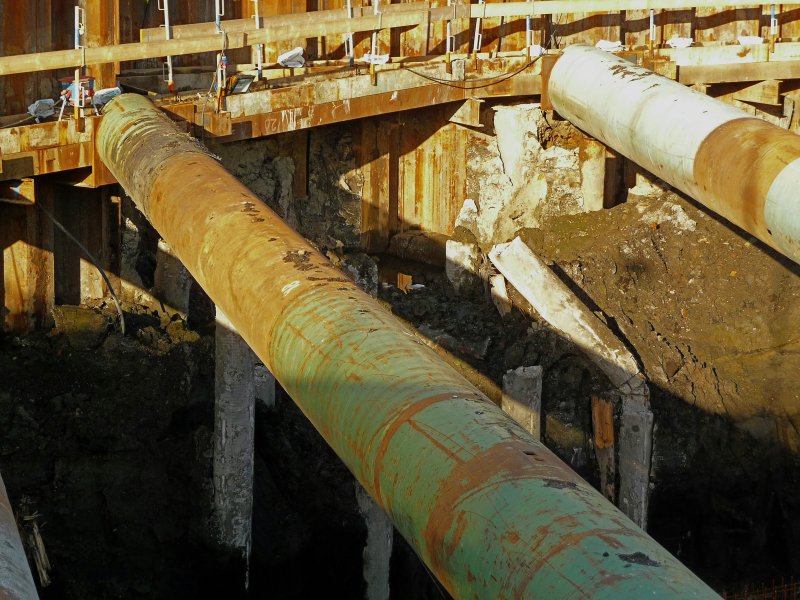
The decision isn’t a matter of preference. It’s a matter of what the camera shows. The two methods solve different failure modes, and a contractor who tries to push you onto the wrong one is either out of equipment or out of honesty.
Pipe bursting
A pneumatic or hydraulic bursting head, roughly the size of a child’s fist, gets pulled through the old line by a winch from the far access pit. The head fractures the existing pipe outward into the surrounding soil. A new HDPE pipe, heat-fused into a single jointless run before the pull, follows the head into the void.
Two access pits. One at the foundation cleanout, one at the city tap or a midpoint. Each pit is roughly 4 ft by 4 ft and 5 to 8 ft deep depending on lateral depth. Once they’re open, the actual pull takes 4 to 8 hours.
Pipe bursting handles the lines that have lost structural integrity: collapsed clay, root-destroyed pipe, scaled-out cast iron, shattered Orangeburg. It’s the only trenchless method that can replace a fully collapsed pipe, because there’s no host pipe left to line. It can also upsize one nominal diameter during the burst: a 4-inch clay lateral can come back as a 6-inch HDPE, useful on undersized older homes that flush slow under load.
What kills a bursting job: extremely shallow burial under 18 inches (no soil for the head to compress fragments into), congested utilities crossing the path (the bursting force displaces surrounding material and can crack adjacent gas or water lines), and depths past 12 ft where the pull rig runs out of mechanical advantage. The pre-job utility locate flags most of these before the quote is firm.
CIPP lining
A resin-saturated felt or fiber liner, sized to the existing pipe ID, gets pulled into place through a single cleanout or inverted through an access pit. A bladder inflates the liner against the host pipe wall, then the resin cures. Cure time depends on the rig: ambient overnight, hot water in 4 to 6 hours, steam in 1 to 2 hours, UV light in roughly 30 minutes for a 75 ft run. What’s left is a structural pipe-within-a-pipe rated for 50 years per ASTM F1216.
CIPP fits cracked-but-intact host pipe: hairline fractures, root intrusion through joints, pinhole corrosion, separated joints with mostly aligned bedding. It’s the move when the line has lost watertightness but still has shape.
CIPP loses about 1/4 inch of wall thickness, dropping a 4-inch ID to roughly 3.5 inches. That’s irrelevant for residential drainage capacity. Fixture units and slope dominate flow on a sewer lateral, not the last quarter inch of diameter.
What kills a CIPP job: severe bellies (the liner follows the existing grade, so a sag stays a sag and pooling continues), full collapse with soil displacement (no host pipe to inflate against), and missing branch tie-ins on a multi-tap line (each branch needs cutting back open after the cure). The last one matters on duplexes and old triplexes more than single-family.
Side-by-side decision matrix
| If the camera shows… | Method | Why |
|---|---|---|
| Cracked but round, root intrusion | CIPP | Cheapest qualifying method, single access |
| Collapsed clay or Orangeburg | Pipe bursting | No host pipe for CIPP to grip |
| Severe belly with pooled water | Open-trench dig | Trenchless can’t fix grade |
| Undersized 3" lateral, slow flushes | Pipe bursting (upsize to 4") | Only method that increases ID |
| Single hairline crack, 6 ft section | Pull-in-place spot liner | Cheapest, ~$3,000–$4,000 |
| Mystery brown spot in the yard | Camera scope first | Don’t quote without diagnosis |
What the camera scope tells you (and what it costs to skip)
A camera inspection is non-negotiable before any trenchless quote. Your plumber pushes a self-leveling cable camera down the line and records video. Notes that come back: pipe material, belly locations, root intrusion, off-set joints, plus the failure distance in feet from the cleanout. Hold onto the recording. It’s yours to keep, and the next contractor who quotes the job will want it.
If your house has an outside cleanout, the scope is straight access and takes about an hour. Without one, the plumber pulls a toilet to reach the line, which doubles the labor and pushes the inspection toward the high end of the range. Adding a one-way cleanout during the trenchless job is a smart add-on: $650 to $2,000 today, and every future scope and snake comes off that fitting instead of through your bathroom floor.
A two-way cleanout costs $1,400 to $3,500 and lets the plumber jet upstream toward the house or downstream toward the city main without repositioning. On any home over 30 years old, the math on a two-way cleanout pays for itself by the second service call.
When trenchless is the wrong call
Not every sewer line should get trenchless work, and a lot of contractor sales pitches gloss over the disqualifications. Here are the situations where dig-and-replace is the honest answer.
Severe bellies are the big one. If the camera shows a section where water pools deeper than 25% of the pipe ID, you have a grade problem, not a pipe-integrity problem. CIPP follows the existing slope. Pipe bursting follows it too, because the new HDPE rides the same path. The only honest fix is open-trench dig with a regrade and re-lay. A contractor who pitches CIPP over a bellied section is selling you a $12,000 job that won’t fix the recurring backups.
Multiple branch connections complicate CIPP. Each tap (basement bath, laundry stack, garage drain) has to be cut back open with a robotic cutter after cure, and contractors typically price this as additional crew time and equipment per connection. On a duplex with five branches, the math often swings back to dig-and-replace.
Unknown utility crossings disqualify pipe bursting until they’re located. A bursting head displaces enough soil to crack a buried gas line at the same depth, so the pre-job utility locate (free, call 811) is mandatory before the rig hits the yard.
City requirements vary. Some municipalities run point-of-sale lateral compliance programs (Oakland and Berkeley in the East Bay, parts of Portland OR, and a handful of others) that force a CCTV scope or full replacement when a property transfers. Check the ordinance for your municipality before you quote. A trenchless job done in violation of a sale-time replacement ordinance comes back to bite at closing.
How insurance handles this
Standard homeowners insurance covers water damage from a sewer backup or burst if you carry a sewer-and-drain rider, paying to dry out the basement, replace the drywall, and remediate mold. It almost never pays for the line replacement itself, which the carrier classifies as a maintenance expense.
A sewer-line rider (sometimes called “service line coverage”) runs $40 to $300 a year and pays a portion of the actual replacement cost when a covered failure happens. On a 50-year-old home with original cast iron, the rider is worth carrying. On a 15-year-old home with PVC, it’s optional. Carrier caps usually fall between $10,000 and $25,000 per claim, which covers the typical trenchless job but can fall short on a long lateral under a stamped patio.
Confirm the rider was active before the failure, not added after. Carriers run loss-history checks, and a claim filed within 60 days of policy modification gets denied for pre-existing condition.
Frequently asked questions
See the FAQ block above for the questions homeowners ask most: cost, method comparison, disqualifications, timeline, and pipe lifespan. The short version: scope first, choose method based on the camera findings, get the permit, and budget for one cleanout add-on if the house is older than 1990.