A garage door opener repair runs $100 to $300 for most failures and $300 to $500 when the failure is in the motor or logic board. The decision that matters more than the repair quote: a new opener installed costs $300 to $800 depending on drive type. When the repair part plus labor crosses about half of that replacement number, and your existing opener is past 10 years, the math says replace, not repair.
The numbers below cover what each component actually costs to fix in 2026, the failure mode that almost always turns out to be a 30-second realignment, and the one age-related red flag that should override any repair quote you’re given.
What an opener repair actually costs
Most repair calls trace to one of six failure modes. The bill depends almost entirely on which one and how old the opener is when it goes.
| Component / repair | Typical 2026 cost | When it usually fails |
|---|---|---|
| Photo-eye sensor realignment (DIY) | $0 | Bumped lens, cobweb, kid’s bike against the bracket |
| Photo-eye sensor replacement (pro) | $125–$300 | Lens housing cracked, wiring chewed, water damage |
| Remote replacement (homeowner) | $20–$70 | Battery dies, button fatigue, frequency drift |
| Remote pairing / troubleshoot (pro) | $100–$350 | New remote that won’t pair, after-market replacement issues |
| Capacitor replacement | $80–$180 | Motor hums but door doesn’t move; ~6–10 years |
| Drive gear / nylon worm gear | $150–$300 | Door starts but stalls; opener whines; ~8–12 years |
| Drive chain or belt replacement | $100–$400 | Chain stretched or jumped; belt frayed; ~10+ years |
| Logic board / circuit board | $200–$400 | Erratic operation, burning smell, dead remote-and-wall-button combo |
| Full motor replacement | $300–$800 | Motor seized or shaft worn; usually past 12 years |
| Service call / trip fee | $50–$95 | Most shops, credited to performed work |
| Hourly labor | $75–$150 | National range; dense metros run higher |
| New opener installed (replacement) | $300–$800 | When the math says replace, not repair |
Two pricing structures homeowners get blindsided by. First, the trip fee: $50–$95 in most markets and higher in dense metros, usually waived if you authorize the work but charged in full if you decline the quote. Second, “opener repair” on a flat-rate quote often hides the breakdown. A shop quoting $349 to “fix the opener” may be replacing a $40 gear and an hour of labor, or it may be padding for a part that doesn’t actually need replacing. Ask which component, ask for the part number, and you’ll separate the working diagnosticians from the production crews.
The 50% rule (and why it usually means replace)
The math is blunt. A new opener installed runs $300 to $800. A logic board for a 12-year-old screw-drive Genie can run $150–$200 in parts alone, plus an hour of labor and a trip fee, which puts the bill at $300–$400 all in. Against a $400–$600 belt-drive replacement that’s already 50–100% of the new-unit price, on a unit well past its 10–15 year lifespan, with no warranty on the new part, and the next failure (gear, capacitor, motor) statistically a year or two away.
The simple decision rule:
- Repair if the part costs less than 30% of replacement AND the opener is under 8 years old. Sensor on a 4-year-old LiftMaster, gear on a 6-year-old Chamberlain, anything under active warranty: repair every time.
- Replace if the part exceeds about 50% of replacement cost OR the opener is over 12 years old. Logic board, full motor, or “two parts at once” on a 12-year-old unit: replace.
- Replace anyway if the existing unit lacks battery backup or photo eyes, regardless of repair quote. Both are 2026 standard and the safety case is non-negotiable.
- The middle band (8–12 years, repair cost 30–50% of replacement) is where shops upsell hardest. The honest answer depends on whether the homeowner wants smart features. Both smart features and battery backup are 2026 standard on new units and absent on most pre-2018 openers.
There is one situation where the rule flips: if the existing opener is a high-end LiftMaster with a lifetime motor and belt warranty still active, an authorized dealer can swap the motor or belt at labor cost only. That can drop a $400 repair to $150. Worth checking before you authorize the work.
Pre-1993 opener red flag
If your existing opener was manufactured before 1993, replace it regardless of what’s broken. The Consumer Product Safety Commission’s UL 325 standard required external entrapment protection (the photo eyes mounted six inches off the floor on each track) for all openers manufactured after 1992. A pre-1993 opener relies only on internal contact reverse, which historically failed often enough to crush children and pets. Per LiftMaster’s safety reference , the 1.5-inch reversing test (lay an object on the floor, hit close, the door must reverse on contact) is the minimum compliance check, and even passing it doesn’t substitute for photo eyes.
A pre-1993 opener gives itself away in a few ways. Black photo-eye sensors near the floor will be missing entirely. Manufacture date stamped on the unit body will pre-date 1993. Remotes will use a single fixed code rather than rolling-code (rolling-code became standard on residential openers through the 1990s). Any of these signals means the unit has aged past its safety standard, not just its mechanical lifespan.
New-opener pricing in 2026
The new-opener decision is split between drive type and horsepower. Drive type is the loudest factor in your monthly experience. Horsepower is the one that determines whether the unit will lift your specific door without overstraining.
By drive type, unit only:
| Drive type | Unit cost | What it sounds like |
|---|---|---|
| Chain drive | $130–$250 | Loud, mechanical clatter; the cheap default |
| Belt drive | $160–$450 | Smooth and nearly silent; the 2026 mainstream |
| Screw drive | $150–$500 | Faster lift; medium noise; less common in 2026 |
| Direct drive | $275–$500 | Quietest, lowest maintenance, German engineering |
| Jackshaft (wall-mount) | $500–$750 | Frees the ceiling for storage racks; quiet |
By brand, the unit-only ranges across HomeGuide and ConsumerAffairs:
- Genie: $150–$450. Strong mid-range value; common at home centers.
- LiftMaster: $225–$500. Premium contractor brand; lifetime motor and belt warranty on premium models.
- Chamberlain: $160–$500. Same parent as LiftMaster (Chamberlain Group); typically a 5-year warranty on the residential models like the 2500.
- Sommer, Linear, Hormann: $150–$700, with Hormann sitting at the higher end on direct-drive units.
Total installed averages $379 per Angi (range $218–$540) or $600 per HomeGuide (range $300–$900). The spread reflects whether the install includes new safety sensors, a battery backup, smart-home connectivity, and an extension kit for taller doors. Two to six hours of labor at $65–$85 per hour is typical for installation, lower than the $75–$150 repair rate because most install work is bolt-up of a pre-assembled rail to existing structure.
Smart-feature gotchas before paying extra
MyQ (Chamberlain Group’s smart-home platform on most LiftMaster and Chamberlain openers) is free for the basic open/close-from-app function but gates several integrations behind a subscription. Amazon Key in-garage delivery, certain HomeKit routines, plus some video features have moved to paid tiers over the years. Check the specific feature you care about before buying.
Battery backup has been required by California law (SB-969, effective July 2019) on residential garage door openers sold or installed in the state, and it’s a sensible $50–$175 add-on everywhere else. The unit keeps working through power outages, which matters in any region with summer storms or rolling blackouts. Most belt-drive openers in 2026 ship with battery backup standard; older or budget chain-drive units don’t.
Wall-mount jackshaft openers (LiftMaster 8500W, Chamberlain RJO70 series) cost $500–$750 for the unit but free up the ceiling, which matters if overhead storage racks or a car lift are in the plan. The trade-off: jackshaft units require a torsion spring system in good condition, and the install often surfaces spring issues that wouldn’t have shown up on a ceiling-mounted opener.
Sensors, remotes, and the cheap fixes most calls actually need

A large share of the “opener won’t work” calls a tech responds to are not opener problems. They’re sensor problems. The black photo eyes mounted on each track at floor level are the single most common failure mode in the entire garage door system, and the fix is usually free.
The diagnostic sequence:
- Check both sensor LEDs. Most brands use one solid green (sender) and one solid red or amber (receiver). If either is blinking, the sensors are misaligned or obstructed.
- Wipe both lenses with a dry microfiber cloth. Cobwebs and condensation block the beam; this single step clears the problem more often than any paid repair.
- Check the brackets are tight. A bumped sensor that’s drifted out of plane will refuse to acknowledge alignment.
- Look for damaged wiring along the track. Mice and weed trimmers cut the low-voltage sensor wires.
- Try the wall button. If the door closes from the wall button while holding it down, the opener works and the sensors are the issue.
If the LEDs are dead entirely, the sensor is bad and a new pair installed by a pro runs $125–$300. A homeowner-installed pair from Home Depot is $25–$50 and a 20-minute job, including running new low-voltage wire if the existing wire is damaged.
Remotes are similarly cheap. A new manufacturer-branded remote runs $20–$40 at a parts counter or $25–$60 at a home center. Pairing takes 30 seconds on most modern units (hold the learn button, press the remote button). If a tech is charging $200 to “replace and pair the remote,” they’re charging for the trip fee and an hour minimum, not the part.
When the gear or motor actually fails
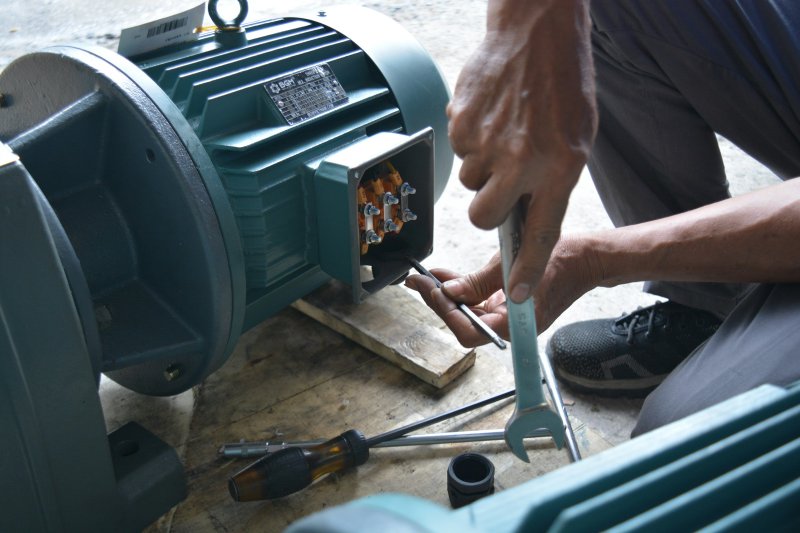
The real opener repairs, meaning the ones worth paying for, are gear and chain failures on units inside their useful life. The diagnostic patterns:
- Motor hums but door won’t move: capacitor or seized gear. Capacitor is $80–$180; gear is $150–$300. Quick fix on a 6-year-old unit; replacement candidate on a 12-year-old.
- Door starts and stalls partway, with grinding noise: stripped nylon worm gear. The single most common drive-train failure on chain-drive openers between years 8 and 12. Gear kit $30–$80 in parts; total job $150–$300 with labor. Worth the repair if the rest of the unit is sound.
- Erratic open/close with no clear pattern, or burning smell: logic board or motor windings. Logic board $200–$400 installed; full motor $300–$800. Both crowd the replacement decision on any unit past 10 years.
- Door reverses immediately after starting to close: safety sensor (cheap) or limit switch (cheap) or a worn travel-limit cam (moderate). Diagnostic call $50–$95; fix usually under $200 if it’s not the logic board.
The honest upsell vs. real repair tell: a competent tech will run through the diagnostic sequence and name the part before quoting. A production-shop tech will quote a flat number and offer “since the truck is on site, you should also…” add-ons. Get a written breakdown of part and labor; if the shop won’t provide one, get a second quote.
Reading a fair repair quote
A reputable garage door opener tech who arrives for an “opener won’t work” call should run through this sequence before quoting: photo-eye check, wall-button vs. remote test, manual disconnect to verify the door is balanced, visual on chain or belt tension, and a logic-board listen test. The quote should name the specific part with its part number, separate parts and labor on the bill, and state the warranty (1-year on installed parts is industry standard for non-warranty work; the manufacturer’s warranty covers parts only, not labor).
What to refuse, in order of how often it shows up:
- “You need a whole new opener” without the tech naming which component failed. On a 6-year-old unit, this is almost always a sales pitch, not a diagnosis.
- “Premium upgrade” parts the original unit doesn’t need. A 1/2 HP belt-drive opener doesn’t need a 1 HP motor unless you’ve added insulation that pushed the door above 350 lb.
- A flat-rate quote that doesn’t itemize parts and labor. The whole industry’s reputation gap traces to this practice.
- Same-day pressure to authorize work the tech can’t fully diagnose. Sensor adjustment is fast; logic-board diagnosis is not, and any quote based on a 5-minute look at a 12-year-old unit deserves a second opinion.
For the related “the door itself won’t move” scope (broken springs, snapped cables, drum issues), see the garage door cable repair guide , which covers the failure modes that are mechanical rather than electrical. And for project-level renovation budgeting, the broader remodeling cost guides cover whole-garage and adjacent-room work.
How to know when you’re past repair territory
A few signals that point past repair regardless of the quote:
- Opener manufactured before 1993 (no UL 325 photo eyes)
- Opener over 15 years old and asking for its second major part replacement
- Repair quote exceeds 50% of a new-opener-installed price
- Existing unit lacks battery backup, smart-home connectivity, or quiet operation that you’d want anyway
- Manufacturer no longer makes parts for the model (common on Genie units past 12 years and Sears Craftsman units of any age)
Any one of those tips toward replacement; two together makes it the obvious call. The $300–$800 install spread on a new unit reflects honest work, not padding, especially compared with throwing $250 at a logic board on a unit that will need a motor swap in 18 months.