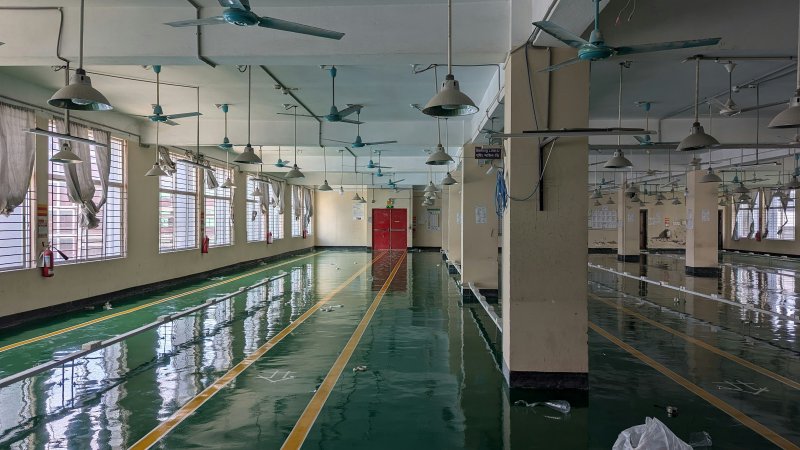
Water mitigation services run $4 to $20+ per square foot in 2026 for the post-extraction phase, with a 3- to 10-day drying cycle, a $200 to $500 daily monitoring fee required by IICRC S500 §11, and equipment day-rates of $25 to $150 per machine per day. A typical 1,000 sq ft Cat 1 clean-water loss with a 5-day drying cycle lands between $4,000 and $8,000 for the mitigation phase alone, before any rebuild scope.
Mitigation is the part of the bill most homeowners do not see coming. Extraction is loud and obvious — the truck shows up, the standing water vanishes, and the crew leaves equipment running on day one. Then the meter runs for a week. This guide explains what the equipment costs day by day, why the daily monitoring fee is a real industry protocol rather than contractor padding, and how the documentation requirements protect the homeowner from a denied supplemental claim.
What water mitigation actually covers
Mitigation is steps 4 through 7 of the IICRC S500 framework: drying, monitoring, content handling with antimicrobial application, and documentation. The first three steps (inspection, categorization, extraction) are owned by the emergency response and live in our emergency water removal cost guide . Mitigation picks up the moment the extraction truck pulls away and the first axial air mover gets staged against a wet baseboard.
The IICRC S500 Fifth Edition (2021) is the ANSI standard contractors are pricing against. It defines what counts as adequate drying, what readings have to be taken and how often, and what documentation closes out the job. A reputable mitigation contractor will work the standard line by line. One that resists explaining which step their invoice corresponds to is a problem worth flagging to the adjuster.
Rebuild scope is a separate contract. After the structural materials hit dry standard (typically 16% moisture content for framing per S500), the mitigation phase ends and the rebuild trade picks up: drywall replacement, flooring install, paint, baseboard, trim. Rebuild is almost always paid through the homeowner’s claim rather than billed direct to the carrier. The full rebuild economics are covered in our water damage restoration cost guide .
Mitigation pricing by water category
Pricing splits across the IICRC’s three categories the same way extraction does. Mitigation-phase ranges run higher than extraction-only because they bake in the multi-day drying cycle on top of daily monitoring, with antimicrobial work and content handling layered onto S500 documentation.
| Category | Source water | Per sq ft (mitigation) |
|---|---|---|
| Cat 1 (clean) | Supply-line break, rainwater, melting snow, tub overflow without contaminants | $4 – $8 |
| Cat 2 (gray) | Dishwasher or washing machine discharge, toilet bowl overflow without feces, aquarium leak | $8 – $12 |
| Cat 3 (black) | Sewage backup, ground-surface storm flooding, prolonged Cat 2 | $12 – $20+ |
Synthesis from Angi 2026 water damage data , HomeGuide’s 2026 cost guide, and PuroClean’s national-average framing. Cat 3 mitigation costs roughly two and a half to three times Cat 1 because every porous material in the contamination footprint has to be removed and disposed of before equilibrium drying can finish. Antimicrobial scope expands, the documentation requirements tighten, and the drying cycle stretches to 7 to 10+ days as the framing finally equilibrates against now-empty wall cavities.
A 1,000 sq ft burst-pipe loss with a 5-day drying cycle therefore lands at $4,000 to $8,000 in mitigation. The same loss as Cat 3 sewage on a 10-day cycle pushes $12,000 to $20,000+, and a multi-room Class 4 disaster with hardwood and concrete saturation can run $40,000+ before the rebuild trade ever shows up.
The drying timeline
| Category | Typical drying duration | What drives the length |
|---|---|---|
| Cat 1 | 3 – 5 days | Standard equilibrium drying with LGR dehumidifier and air movers; minimal demolition |
| Cat 2 | 5 – 7 days | Antimicrobial application before final dry; selective demolition adds re-equilibration time |
| Cat 3 | 7 – 10+ days | Porous materials removed first, then framing equilibrates against open cavities; HEPA AFD running negative pressure throughout |
Today’s Homeowner’s 2026 update via PuroClean states “a typical drying cycle takes 3 to 5 days” for Cat 1 work, and that aligns with what the equipment actually does. The math is moisture mass transfer: a 130-pint LGR dehumidifier (Dri-Eaz LGR 7000Xli class) pulls roughly 16 gallons of water per day under realistic conditions, and a 1,000 sq ft loss with 2 inches of intrusion holds about 1,250 gallons before extraction. Past extraction, residual structural moisture in the lower 24 inches of drywall and the framing behind it is what the dehumidifier is chasing.
When Class 4 saturation is in play (hardwood floors, concrete slabs, brick), expect 14 to 21 days because those materials release moisture an order of magnitude slower than gypsum or framing lumber. Specialty drying mats and panel systems get added at that point, with their own day-rates that the carrier will challenge unless documented daily.
Equipment day-rates and the rule of thumb
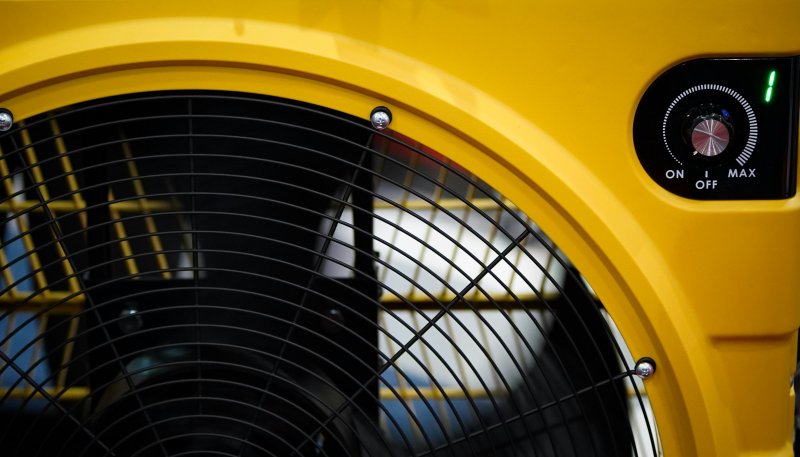
Equipment is rented to the job by the day. Each machine shows up as its own line item on the daily invoice, and the count should match what is actually plugged into a wall during the monitoring visit. Verifying this is the single most useful thing a homeowner can do during the dry-out.
| Equipment | Per machine, per day | Output |
|---|---|---|
| Axial air mover | $25 – $45 | 2,500 to 5,400 CFM (Phoenix AirMax, Dri-Eaz Velo, B-Air VPX34) |
| Centrifugal air mover | $30 – $50 | 1,500 to 3,200 CFM |
| LGR dehumidifier (mid) | $50 – $100 | 80 pints/day AHAM (Dri-Eaz Revolution) |
| LGR XL dehumidifier | $100 – $150 | up to 130 pints/day (Dri-Eaz LGR 7000Xli) |
| Desiccant (commercial) | $200 – $500 | 600 to 2,000+ CFM; dries below 40°F where LGR fails |
| HEPA AFD / air scrubber | $40 – $75 | 500 CFM (Phoenix Guardian Pro R, Dri-Eaz DefendAir HEPA 700) |
The Reets Drying Academy equipment guide publishes the industry rule of thumb: for every 1 XL dehumidifier, plan on 7 to 8 air movers and 1 AFD per drying chamber. On a 1,000 sq ft Class 2 loss with a single drying chamber, that pencils out to roughly $125 (XL LGR) + 7 × $35 (air movers) + $55 (AFD) = $425 per day in equipment alone, before any tech labor or monitoring fee. Across a 6-day Cat 2 cycle, equipment alone runs $2,550. Add tech labor and the daily M-Fee on top.
Cold-weather losses change the math. LGR dehumidifiers stall below 40°F because the refrigeration cycle that condenses water onto the cold coil cannot run effectively at low ambient temperature. Desiccant units (which use silica gel or molecular sieve to chemically capture moisture) take over but bill at $200 to $500 a day per unit. A New England burst-pipe loss in February gets expensive fast for this reason.
The daily monitoring fee, decoded
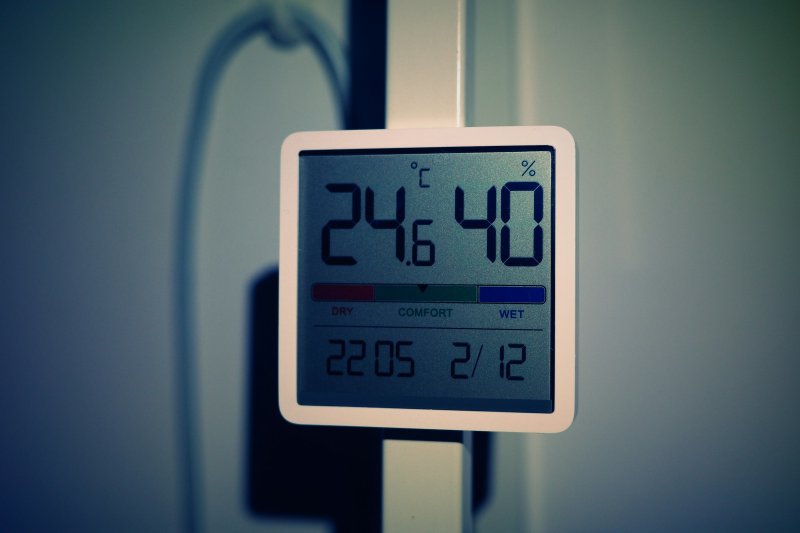
The daily monitoring fee shows up as M-Fee on Xactimate-coded invoices and runs $200 to $500 per visit on residential losses. The fee covers a required IICRC S500 §11 protocol, not a casual stop-by:
- Psychrometric readings at supply air (entering the chamber), return air (leaving the chamber), an unaffected reference area outside the chamber, and inside the wet structural materials. Each reading captures temperature, relative humidity, dew point, and grains per pound (GPP) — the four psychrometric values the drying chamber model runs against.
- Material moisture content readings on framing, drywall, and saturated specialty materials. The meter is a calibrated unit such as a Delmhorst BD-10, a Protimeter SurveyMaster, a Tramex ME5, or a comparable industry-grade instrument.
- Equipment check, repositioning when airflow has dead zones, and adding capacity if the GPP differential between supply and return is closing slower than the drying chamber model predicted.
- Written drying log entry and a daily progress note submitted to the adjuster.
This is also the documentation that protects supplemental billing. If the materials do not hit dry standard on the original schedule, the contractor can submit a supplement request for additional drying days. Without the daily psychrometric log, the carrier is fully justified in denying the extension. Many adjusters will reject any supplemental day that lacks a corresponding log entry, and the homeowner ends up arguing through their own carrier’s appeals process about a bill the contractor cannot defend.
The standard frequency is once per 24 hours during active drying. Larger losses (multi-room, multi-floor) may run two visits per day, billed at $500 to $1,000 per visit. A contractor offering a flat weekly rate instead of a per-visit M-Fee is using a non-standard pricing structure, which is fine but should be documented in writing on the work authorization before equipment goes in.
When the drying cycle blows past schedule
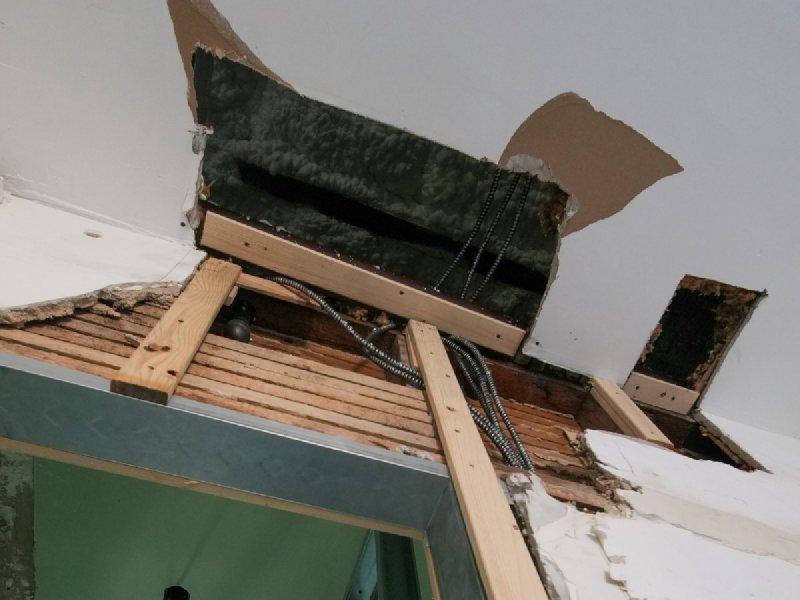
Supplemental drying days are the second-most-common dispute on a mitigation invoice after categorization. The original work authorization will quote a drying duration based on category and class — say, five days for a 1,000 sq ft Cat 1 burst-pipe loss. If on day five the framing is still reading 18% moisture content (above the typical 16% dry standard for Class 2 framing), the contractor needs another two days of equipment and monitoring. That supplement is roughly $1,000 to $1,500 of additional billing — equipment day-rate stack and M-Fee — and the carrier will challenge it without strong documentation.
Three things drive supplemental days legitimately. First, ambient conditions outside the modeled range: a January loss in an unheated basement at 42°F sends a refrigerant LGR into a stall that the crew did not anticipate when sizing the chamber. Second, hidden saturation discovered mid-cycle: a moisture map taken on day three reveals wicking up the back of a stud bay that was not visible at extraction. Third, secondary failure: a partition wall releases moisture into the next room when the first chamber’s pressure differential breaches a vapor barrier.
A capable contractor catches these on the day they occur, documents them in the drying log with the timestamp and instrument reading, and submits the supplement request the same day. A weak contractor surfaces them at close-out as a surprise. The carrier has every right to deny a supplement that surfaced for the first time on the final invoice with no corresponding daily entry, and homeowners caught in that situation are usually on the hook for the difference.
Antimicrobial application
Antimicrobial application is required scope on Cat 2 and Cat 3 losses per S500 §12. The Xactimate code is WTR_AM, and the rate runs $0.25 to $0.75 per square foot of treated surface, with the upper end reserved for heavy applications on porous Cat 3 surfaces.
The treatment is applied after extraction and demolition but before the final equilibration drying. The contractor is suppressing microbial growth in the wet substrate during the 5- to 10-day window, not killing existing mold colonies. Mold remediation is a separate IICRC S520 standard, billed at $15 to $30 per square foot, and is typically out of scope for mitigation. If the project drifts past the 48-hour mold window because extraction got delayed or the drying cycle ran long, the scope can shift mid-job. Our mold damage cost guide covers the threshold and the HO-3 mold sublimit math.
Cat 1 losses do not require antimicrobial application as a default. Some contractors will quote it anyway for liability cover — that is not unreasonable, but it should appear as an optional line rather than a required one, and the homeowner can decline it on a clean-water loss without violating the standard.
Content manipulation, often missed
Content manipulation runs $0.40 to $0.80 per square foot of affected room and shows up on Xactimate as CON_MFR1 (light: move and pad-block furniture for drying access) or CON_MFR3 (heavy: full pack-out to climate-controlled storage and pack-back at completion).
This is the line item that catches homeowners by surprise because the contractor never mentions it during the emergency call. A 1,000 sq ft loss with full furniture in three rooms can add $400 to $800 of content scope, and a CON_MFR3 pack-out for valuables on a Cat 3 sewage event runs into thousands. Ask for content scope to appear on the work authorization up front, broken out by room, with a stated CON code rather than a vague “contents” line.
Documentation: the drying log

By close-out, the project file should contain a daily psychrometric log, before-and-after photos, a moisture map of the affected rooms with start-state and end-state readings, and a signed completion certificate stating that materials hit dry standard.
This documentation is what releases the rebuild trade to start work. It is also what the carrier audits when reviewing the mitigation invoice against Xactimate line items. A contractor who hands back a clean log — daily psychrometric readings with named-instrument calibration, signed entries, and end-state photos — has been running the standard. One who hands back a single end-of-job summary either ran the dry-out without the documentation or chose not to maintain it. Either signal is worth noting before the same crew gets a follow-up insurance referral.
The completion certificate also matters when selling the home later. Disclosure laws in most states require past water-damage events to be reported, and a documented mitigation file with daily psychrometric proof of dry-back is a strong rebuttal to any future buyer’s concern about hidden mold or structural damage.
Verifying the contractor
A few minimum credentials carry weight in 2026:
- IICRC WRT (Water Damage Restoration Technician) certification on the lead tech. The 84-question exam, $80 fee, 14 CECs every 4 years protocol is published at iicrc.org/wrt , and homeowners can request the technician’s IICRC number and verify it on the public registry.
- IICRC ASD (Applied Structural Drying) certification for any Class 3 or Class 4 loss. ASD covers the psychrometric math and equipment placement that drives the daily M-Fee documentation. Without an ASD-certified tech running the chamber, the daily readings are getting taken by someone who may not understand what they mean.
- Direction of pay agreement, with the contractor billing the carrier direct on the mitigation invoice. Avoid a contractor who insists on the homeowner advancing the mitigation cost; that is a working-capital problem the homeowner does not need to absorb.
- Written work authorization with line-item Xactimate codes for extraction, drying days, M-Fee, antimicrobial (WTR_AM), and content (CON_MFR1 or CON_MFR3). A contractor who quotes a flat per-square-foot number without showing the code structure is hiding the math.
The “free water damage inspection” loop is worth flagging explicitly. The same company that scopes the loss is the company billing for it, and there is no third-party check on the categorization. Cat 1 versus Cat 2 doubles the per-square-foot rate; Cat 2 versus Cat 3 nearly triples it. If the categorization looks wrong, request the adjuster send a separate inspector before signing the work authorization — the carrier has a financial incentive to verify it and most will dispatch an independent within 24 hours. A contractor who calls the loss Cat 2 when the source water was clearly Cat 1 (a known supply-line break inside the first 12 hours) is leaving money on the carrier’s table that the homeowner will eventually see in a higher claim history and a renewal premium increase. The IICRC S500 framework allows for re-categorization if water conditions change, and a competent crew will document the timestamp of any drift between categories in the drying log — the timestamp an adjuster needs when adjudicating disputed line items at close-out.